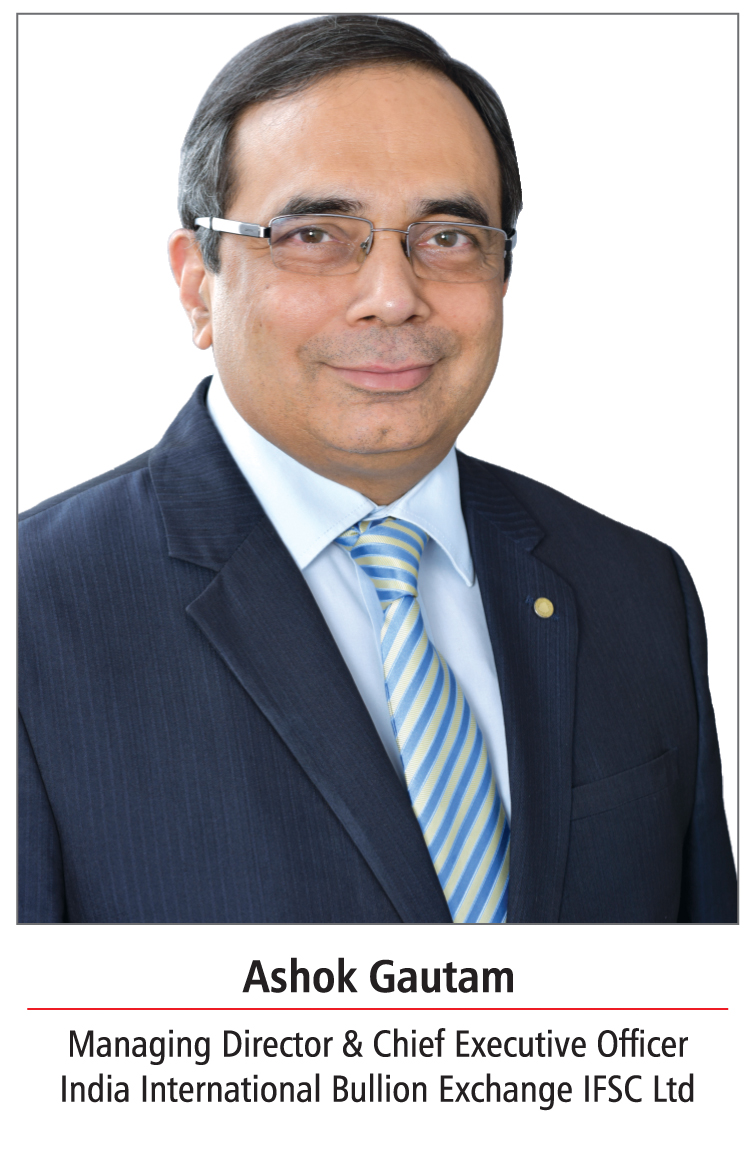
In an exclusive with Ashok Gautam, Managing Director & CEO, India International Bullion Exchange IFSC Ltd, The New Jeweller Bureau – GPM gets an insight on the cutting edge infrastructure built by the exchange for seamless transactions. In this exclusive he also elaborates the ‘Spot Market’ feature of IIBX. Excerpts:
Can you tell us the purpose of initiating IIBX in India and how has IIBX helped transform or structure the Bullion sector in the country?
The launch of the India International Bullion Exchange (IIBX) was a landmark event aimed at bringing greater transparency, efficiency and global competitiveness to India's bullion ecosystem. As one of the world's largest consumers of Bullion, India historically played a limited role in determining global bullion prices despite accounting for significant demand. IIBX was established at GIFT IFSC, Gandhinagar, to create a world-class trading platform that enables direct bullion imports, transparent price discovery, responsible sourcing and a more organized market structure. Since its launch by Prime Minister Shri Narender Modi, in 29 July 2022, IIBX has helped transform the bullion sector by creating a centralized and regulated marketplace that connects global suppliers directly with Indian buyers. The exchange has reduced dependence on fragmented import channels and enabled qualified jewellers to import bullion directly through the platform, improving efficiency, competitiveness and supply chain transparency.
In the current scenario IIBX can list refiners who are accredited with either LBMA or UAEGD. Can you elaborate on this, and can India establish its own Good Delivery system for refineries in the future? Your opinion.
IIBX permits bullion from refiners accredited by globally recognized standards such as LBMA (London Bullion Market Association) and UAE Good Delivery (UAEGD), ensuring that gold traded through the exchange meets internationally accepted benchmarks for purity, quality, traceability and responsible sourcing. This strengthens confidence among both global suppliers and domestic buyers.
In our view, an India / IFSCA Good Delivery Standard would be a natural progression for the country's bullion market and would support India's aspiration to become a leading global bullion trading hub.
Can anybody in the business of bullion become a member of IIBX? Please explain the process to our readers?
Membership of IIBX is open to all eligible entities across the bullion value chain, including Jewellers, bullion traders, exporters, refiners who meet the qualifying criteria as specified by the IFSCA. Qualified Jewellers, TRQ holders, Advance Authorisation Holders, GJEPC RCMC holders, Nominated Banks, international suppliers, refiners, and other participants can come on IIBX ecosystem as a client or a special category client of a Trading / Clearing Member of IIBX, subject to continuously meeting the eligibility criteria prescribed by the IFSCA.
IIBX boasts of a robust Technology platform that enables seamless transactions. Can you tell us about this cutting-edge technology implementation and its benefits to members?
Technology is one of the key pillars of the India International Bullion Exchange. We have built a modern, secure and resilient exchange infrastructure that meets global standards of performance, reliability and cybersecurity while addressing the unique requirements of physical bullion markets.
IIBX operates a fully electronic trading platform with integrated order matching, real-time risk management, surveillance, clearing and settlement, enabling seamless execution of transactions from order placement to settlement. The platform supports multiple modes of market access including Trading Workstations (TWS), web-based trading, APIs and algorithmic trading interfaces, allowing participants to integrate their internal systems with the Exchange. The technology infrastructure is hosted across geographically separated Primary and Disaster Recovery sites with one-to-one redundancy, ensuring high availability and business continuity. The platform is protected through multiple layers of cybersecurity controls including Web Application Firewalls (WAF), DDoS protection, Next Generation Firewalls, VPN-based secure connectivity, Privileged Access Management (PAM), Endpoint Detection & Response (EDR) and a 24×7 Security Operations Centre (SOC).

Another significant feature is the seamless integration of the Exchange with the Depository & Clearing Banks. This enables electronic processing of Bullion Depository Receipts (BDRs), straight-through settlement, efficient fund movements and secure transfer of ownership. For market participants, this translates into faster execution, real-time risk monitoring, secure connectivity, operational resilience, enhanced transparency and an efficient post-trade experience. The technology platform has been designed not only to meet current market needs but also to support evolving market requirements.
Can you elaborate on the 'Spot market' feature of IIBX and its efficiency in terms of transactions?
The IIBX Spot Market has transformed the way physical bullion is traded and imported into India by providing a transparent, exchange-based marketplace backed by internationally accepted standards. Unlike traditional over-the-counter transactions, trading on IIBX is conducted electronically through an order-driven platform that offers transparent price discovery and standardized contract specifications. The Exchange currently offers a range of spot contracts across various purities, weights, approved refineries, settlement cycles and delivery locations, enabling participants to choose products that best suit their business requirements.
A distinctive feature of the IIBX Spot Market is the use of Bullion Depository Receipts (BDRs), which represent ownership of physical bullion stored in IFSCA-registered and IIDI-empanelled vaults. Trading in BDRs eliminates the need for immediate physical movement of bullion and enables efficient transfer of ownership through the depository system. The settlement framework has been specifically designed for speed and efficiency. For T+0 contracts, BDR settlements are processed every 30 minutes, while funds settlement takes place 4 times in a day with trading hours from 9 am till 9:30 pm, allowing participants to receive ownership of BDR and funds much faster than conventional settlement mechanisms. T+2 contracts are also available to cater to participants requiring a longer settlement cycle.
The Spot Market has also created a regulated gateway for bullion imports into India. Qualified Jewellers, Qualified Suppliers, nominated banks and other eligible participants can access the Exchange under the regulatory framework prescribed by IFSCA. The Exchange supports responsible sourcing, internationally aligned market practices and electronic integration across trading, depository, vaulting and settlement infrastructure.
Together, these features make the IIBX Spot Market highly efficient by providing transparent pricing, faster settlement, secure ownership transfer, reduced operational risk and improved ease of doing business for domestic as well as international market participants.
Can you tell us the future roadmap of IIBX in terms of expansion?
The long-term vision is to make IIIBX a major international trading platform not only for import of bullion in India, but also a significant global centre for 2-way bullion trading and price discovery. This would entail expanding the product suite, which already includes Gold and Silver Futures, to REPO, Lending and Borrowing of bullion, allowing Gold and Silver Funds to access bullion through IIBX, launch USD denominated ETFs, attract global investment in bullion through promoting BDR and Fractionalised BDRs as investment products etc. The first 2 words of India International Bullion Exchange (IIBX) define us, i.e., promoting India as an International Bullion trading hub.